Compliance Implications of Google's $1.375 Billion Settlement with Texas
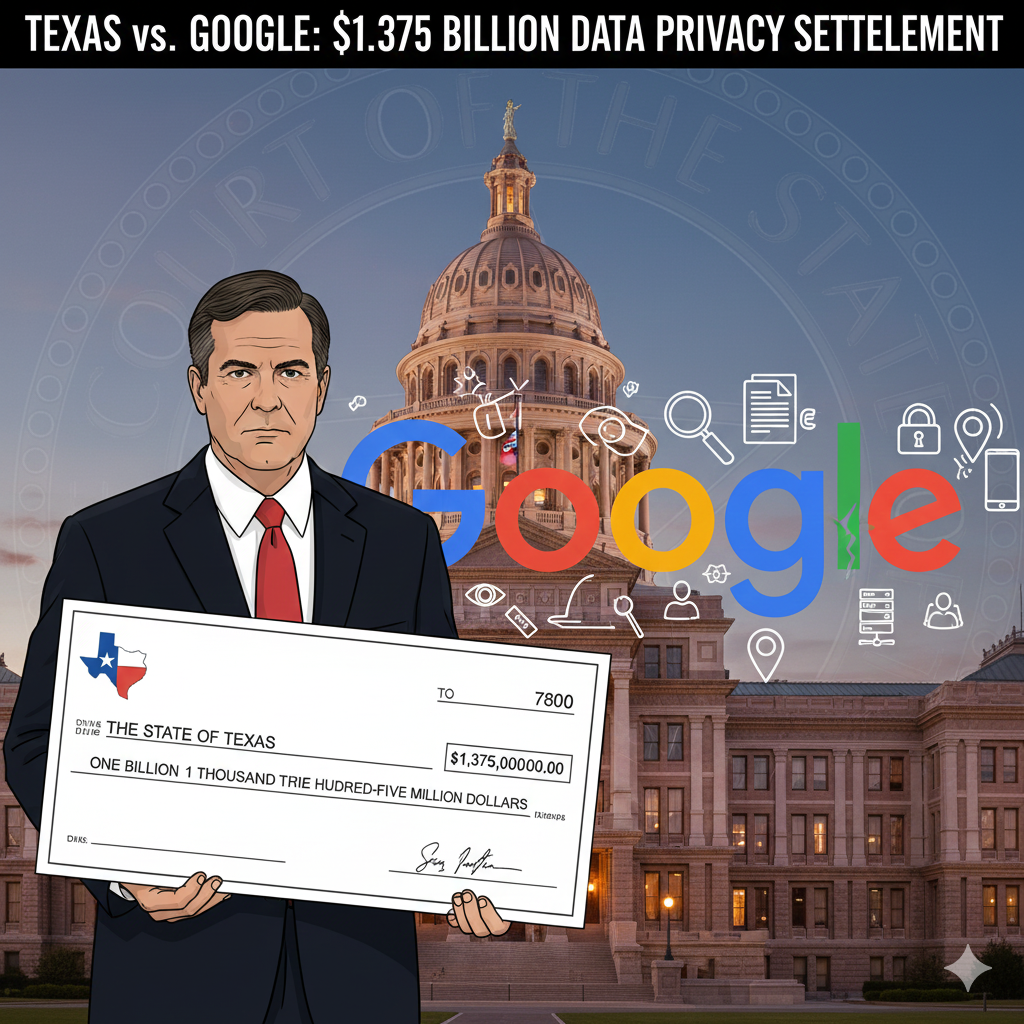
On May 9, 2025, Texas Attorney General Ken Paxton announced that Google had agreed to pay approximately $1.375 billion to the state of Texas to settle multiple lawsuits alleging that it collected user data without user consent.
I. Brief Introduction
On May 9, 2025, Texas Attorney General Ken Paxton announced that Google had agreed to pay approximately $1.375 billion to the state of Texas to settle multiple lawsuits alleging that it collected user data without user consent. This settlement sets a record for Google's largest settlement to a single state in a privacy case (previously, Google's total settlements with 40 states amounted to $391.5 million). The lawsuits accused Google of three major violations of user privacy:
(1) illegally tracking and recording users' geographical location even when users thought they had turned off the relevant functions;
(2) misleading users into believing that data would not be collected in Chrome's "Incognito Mode"; and
(3) collecting millions of biometric identifiers, including facial features, voiceprints, and fingerprints, without users' explicit consent through applications such as Google Photos and Google Assistant.
The aforementioned allegations correspond to multiple separate lawsuits filed by Texas against Google, which were resolved in this settlement. Google did not admit wrongdoing and stated that its product functions did not require modification (the functions in question were all existing), but claimed it would establish a more robust privacy management mechanism when providing services in the future. It is worth noting that back in July 2024, Meta Inc. was also fined $1.4 billion by Texas and settled for using facial recognition data from Facebook and Instagram platforms without user authorization. These consecutive large-scale settlements highlight Texas's strong enforcement stance against tech companies' misuse of users' biometric information.
II. Legal Focus
(I) What is the Texas privacy legal framework? What are its core provisions?
Texas has been relatively active in enacting privacy legislation. As early as 2009, it passed the Texas Capture or Use of Biometric Identifier Act (CUBI), becoming one of the few states after Illinois to have specific legislation targeting biometric information such as faces and fingerprints.
The core provisions of the CUBI law include: the prohibition of collecting an individual's "biometric identifiers" (including iris, retinal scans, fingerprints, voiceprints, and geometric features of the hands and face) for commercial purposes without prior notice and consent. Furthermore, companies are prohibited from selling, leasing, or disclosing such biometric data to third parties (except for specific exceptions such as obtaining a warrant for law enforcement, completing a user-authorized financial transaction, or identifying a missing or deceased individual). Entities holding biometric information must also implement reasonable security measures no less stringent than those for other confidential information and must delete the information "appropriately" (no later than one year) after the collection purpose has been achieved. Each violation of CUBI can be subject to a civil penalty of up to $25,000, enforced exclusively by the state attorney general. It is through this law that Texas has been able to sue companies like Google and Meta for collecting facial recognition data without consent and seek substantial fines.
Regarding the protection of minors' privacy, Texas's SCOPE Act (Children's Online Safety Through Parental Empowerment) also officially came into effect last year, requiring digital service providers (such as companies that own websites, applications, and software) to obtain parental or guardian consent before collecting data from minors under the age of 18. Texas has also launched lawsuits against several large technology companies, including TikTok, under this law.
(II) Similar Regulations in Other Regions: US State Laws and EU GDPR:
In the United States, besides Texas, Illinois' Biometric Information Privacy Act (BIPA, 2008) is another well-known state-level biometric privacy law. BIPA requires companies to inform individuals of the purpose of collection and retention period and obtain written consent before collecting and storing biometric information such as fingerprints and facial geometric scans, and to publish their data retention policies. Failure to comply can result in individual lawsuits, with statutory damages ranging from $1,000 to $5,000 for each violation. Facebook previously paid approximately $650 million in damages for violating BIPA with its facial tagging feature. Washington State (2017) and New York, among others, have also enacted their own biometric privacy laws or regulations. The overall trend is that more states are using comprehensive privacy laws to classify biometric data as "sensitive" information and provide special protection.
In the European Union, biometric data is classified as a "special category" of personal data under the General Data Protection Regulation (GDPR) and is subject to stricter protection. Article 9 of the GDPR generally prohibits the processing of biometric data used to uniquely identify an individual unless specific conditions are met (such as explicit user consent, necessity for maintaining human physiological safety, being in a significant public interest, and having a legal basis). In the EU, in addition to obtaining "explicit" user consent, such data processing typically requires a Data Protection Impact Assessment (DPIA) and adherence to principles such as minimal collection, limited use, and enhanced security. Violations can result in fines up to 4% of a company's global annual turnover under the GDPR.
III. Key Issues Analysis
(I) Why are companies repeatedly held accountable for collecting biometric information without consent? The core reason why large tech companies like Google repeatedly face lawsuits over biometric data is that their products collect and utilize highly sensitive personal information without the user's informed consent. Take Google Photos' face grouping feature as an example: it automatically scans facial features in user-uploaded photos for clustering and archiving. However, in some regions, this process is neither notified beforehand nor does it obtain written informed consent, nor is a data storage policy published, thus being considered a privacy violation. Companies often enable these automated biometric recognition functions for all users by default, aiming to provide convenience or improve the user experience, without fully considering the legally required boundaries of "express consent." This disconnect between technological automation and the user's right to know is precisely why Google, Facebook, and others are being held accountable: the law does not make exceptions simply because the recognition is automated; on the contrary, it emphasizes that no matter how "unobtrusive" the technology may seem, authorization must be obtained whenever biometric information is collected. Google was accused in the Texas case of "secretly collecting" users' facial and voiceprint data without clearly informing them of its intended use, precisely because its default-enabled facial and voice recognition functions crossed the privacy red lines set by law.
(II) How is "processing" of biometric information defined legally? Does uploading a photo constitute "collection"?
From a legal definition perspective, the processing of biometric information encompasses all stages, including collection, storage, analysis, and sharing. In laws like the Biometric Act, "acquiring" or "capturing" biometric identifiers refers not only to directly recording fingerprints or irises but also to actions such as extracting facial feature points or voice models from images and audio using technology. Therefore, if a user uploads a photo containing a face, and the platform's algorithm scans and analyzes it to extract facial geometric feature data that can be used to identify the user, then legally this constitutes the collection/processing of biometric information.
As stated in the Illinois BIPA lawsuit, Google Photos' scanning and analysis of facial structures in user photos and storage of facial templates constitutes "collection and storage of biometric information," requiring prior notice and written consent. Similarly, a voice assistant recording a user's voice and creating a voiceprint model is also considered the collection of voiceprint recognition information. It's important to note that even if this data originates from user uploads or provision, companies cannot consider this tacit authorization—regulations require "explicit prior consent," typically achieved through a separate consent process or a setting switch, rather than being included in a lengthy user agreement.
IV. Implications and Risk Warnings for Overseas Products
Therefore, facing strict biometric privacy regulations in places like Texas, companies expanding international business should pay attention to the following: Sensitive Data Classification and Minimization Principles: Classify biometric information such as facial recognition and voiceprints as highly sensitive data categories, strictly adhering to the principle of "minimum and necessary" collection, avoiding excessive collection of user biometric features for non-core functions. System design should implement "privacy minimization," processing only the biometric information necessary for providing the service by default.
Compliance is More Than Just One-Time Consent: Relying on a "blanket" consent during user registration cannot be considered as authorization for all subsequent sensitive data processing. The most compliant approach is to provide a separate pop-up prompt and explicit consent when functions involving facial recognition and voice are enabled, and to provide an option to withdraw consent at any time. Technical processes need to incorporate compliance considerations, ensuring "compliance by default," and preventing silent data collection without informing users.
Geopolitical factors are a key consideration: Texas's enforcement action against Google reflects a general upward trend in state-level privacy regulation in the United States. With federal legislation stalled, more and more states are filling the gap through their own laws or strengthened enforcement. On the other hand, it's crucial to recognize that some data enforcement cases may be driven by geopolitical considerations. For example, due to national security and user privacy concerns, Western countries have been particularly vigilant and strict regarding the data collection practices of Chinese internet companies in recent years. This means that beyond compliance, it's essential to pay attention to host country policy trends and public opinion, and guard against additional scrutiny due to policy changes or international tensions.