Taiwan Announces First AI Basic Law, Establishing AI Governance Principles and Risk Classification Framework
On January 14, 2026, Taiwan announced the "Artificial Intelligence Basic Law." This is the region's first dedicated law on artificial intelligence.
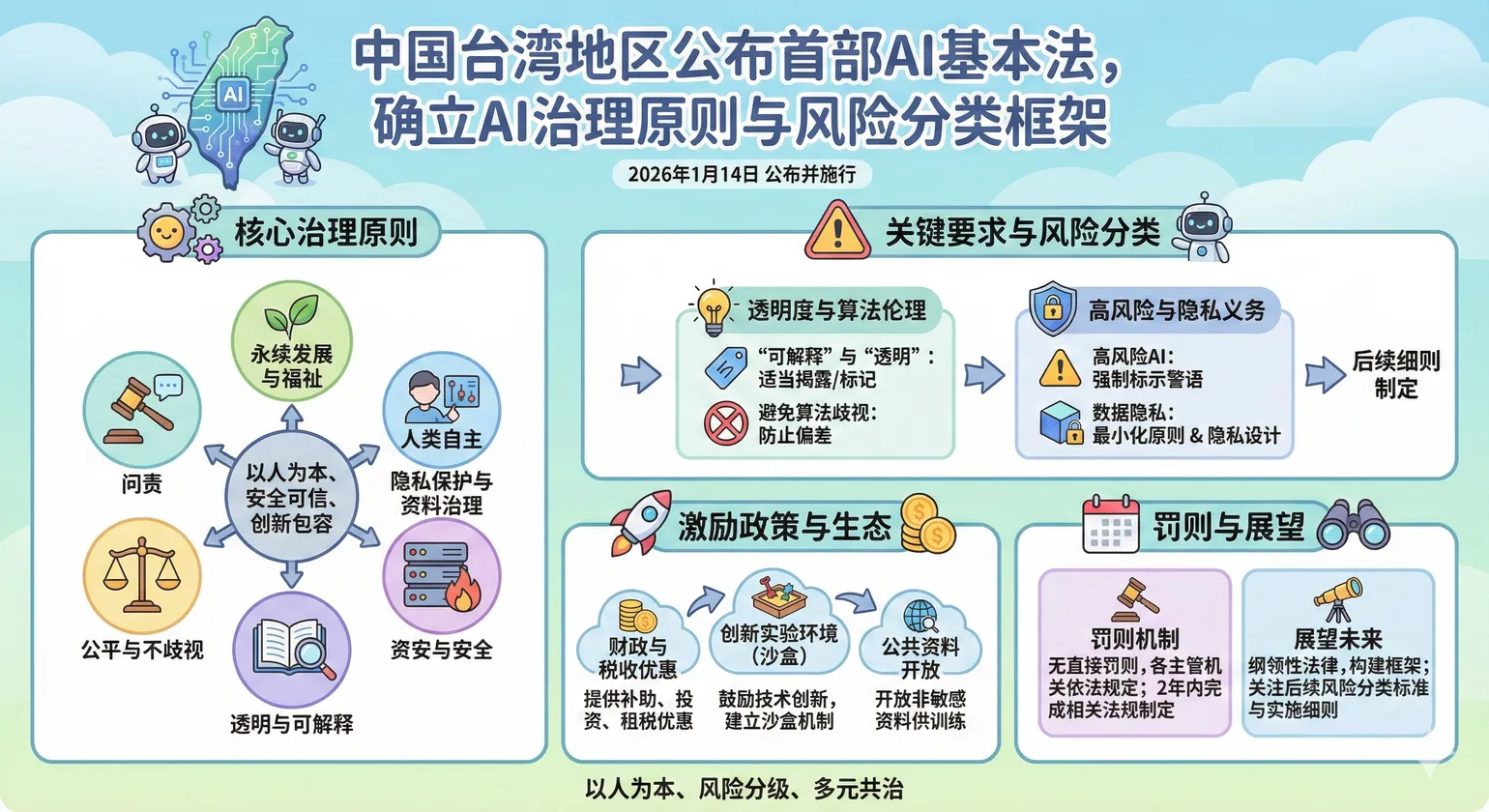
On January 14, 2026, Taiwan announced the "Artificial Intelligence Basic Law." This is the region's first dedicated law on artificial intelligence. The law aims to build a human-centered, safe, trustworthy, innovative, and inclusive AI governance framework, encouraging technological development and industrial applications while also emphasizing risk management and rights protection.
1. Overview of the Bill
On January 14, 2026, Taiwan announced the "Artificial Intelligence Basic Law" (hereinafter referred to as the "Taiwan AI Law"), which came into effect immediately. The law consists of 20 articles and is Taiwan's first comprehensive basic law specifically addressing the field of artificial intelligence. It aims to establish an AI governance framework, promote human-centered AI research and development and industrial development, build a safe AI application environment, implement digital equality, and ensure that technological applications comply with social ethics. The Taiwan AI Law mainly consists of principled and guiding provisions, with specific implementation details to be formulated by relevant authorities later.
2. Core Content
2.1 Seven Governance Principles
The Taiwan administrative authorities promote AI research and application following the following principles:
(1) Sustainable development and well-being;
(2) Human autonomy;
(3) Privacy protection and data governance;
(4) Cybersecurity and safety;
(5) Transparency and explainability;
(6) Fairness and non-discrimination;
(7) Accountability.
2.2 Key Requirements
The Taiwan AI Law is a framework law, focusing on establishing principles and indicating directions, with specific regulatory details to be formulated later. Its key requirements are as follows:
(1) Transparency and avoidance of algorithmic discrimination
● Ensuring "explainability" and "transparency" (Art. 4): AI products (especially when generating content or making decision recommendations) need to provide appropriate information disclosure or labeling.
● Avoiding algorithmic discrimination (Art. 4, Art. 5): During AI research and development and application, algorithmic bias or discriminatory results against specific groups should be avoided.
(2) Special obligations for high-risk AI
● Mandatory warning labels (Art. 5): If an AI product is identified as a "high-risk application," it must clearly display warnings or precautions on the product interface.
(3) Data Privacy and Security Obligations
● Minimization Principle (Art. 4, Art. 14): During the AI research and development and application process, unnecessary collection, processing, or use of personal information should be avoided.
● Privacy Protection by Design (Art. 14): Employ privacy-enhancing technological measures to prevent data breaches.
2.3 Incentive Policies
(1) Fiscal and Tax Incentives: The Taiwan authorities will allocate sufficient budget within their fiscal capacity to provide financial incentives such as industry subsidies, investments, and tax breaks.
(2) Innovative Experimentation Environment: To encourage technological innovation, the Taiwan authorities will establish or improve an innovative experimentation environment (sandbox mechanism) for AI research, development, and application services.
(3) Open Public Data: The Taiwan authorities will establish a mechanism for data openness, sharing, and reuse, making non-sensitive data available for AI training and reuse.
2.4 Penalties and Effective Date
(1) Penalties: The Taiwan AI Act does not directly set penalties, but requires relevant competent authorities to stipulate them in their respective laws and regulations. Within two years after the implementation of the Taiwan AI Act, the Taiwan administrative agencies should complete the formulation, amendment, or repeal of relevant regulations.
(2) Effective Date: Effective from January 14, 2026.
3. Conclusion and Outlook
The "Artificial Intelligence Basic Law" is the guiding law for AI governance in Taiwan, emphasizing a people-centered approach, risk classification, and multi-stakeholder governance. Its characteristics include: proposing seven principles as the foundation for AI research and development and application; constructing a risk classification framework to provide a basis for subsequent detailed regulations; focusing on data governance and personal privacy protection; encouraging innovation and industrial support, and providing financial support.