Latest Compliance Guidelines for Minor Data Privacy Protection
This article summarizes the laws and enforcement cases concerning minors' privacy protection in the aforementioned jurisdictions, and adds Brazil's recently passed Digital Children and Youth Law and Australia's Children's Online Privacy Guidelines.
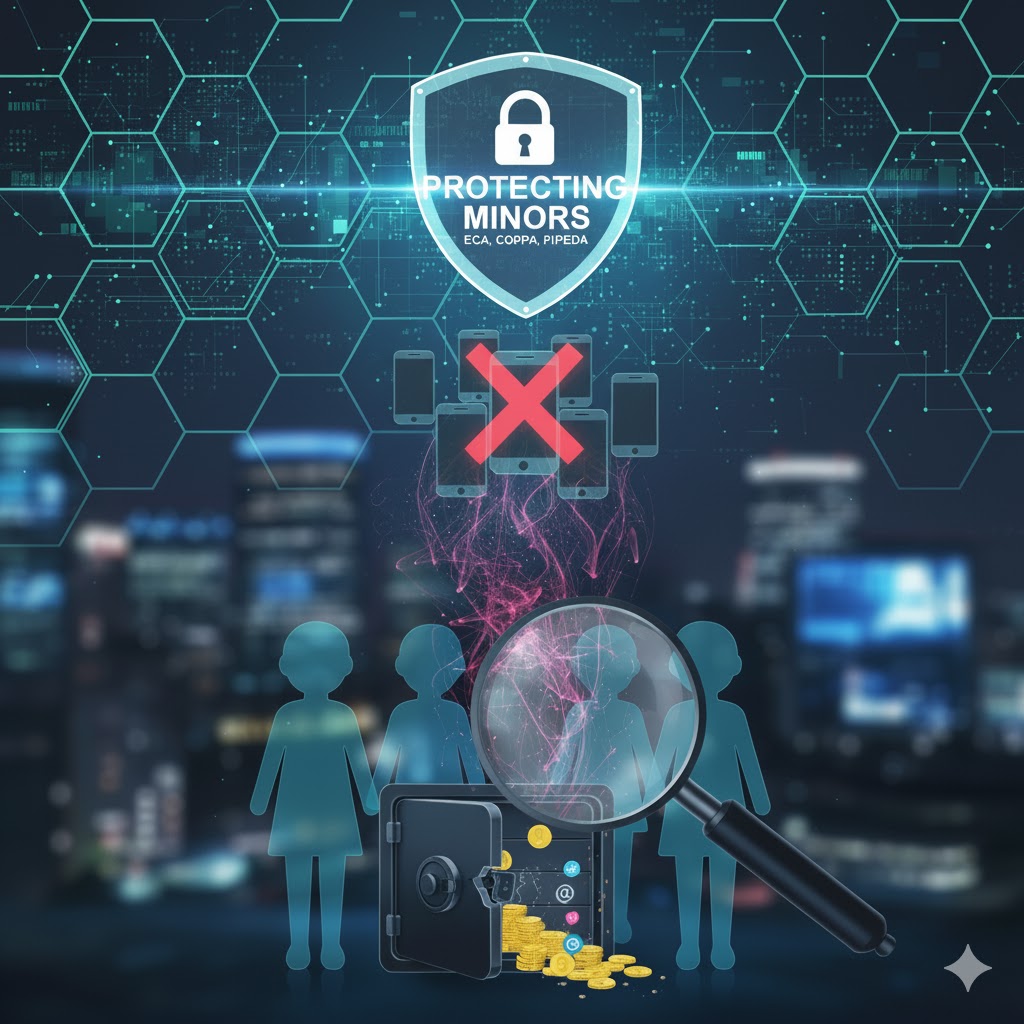
The protection of minors' privacy overseas has always been a key focus of overseas privacy laws and a primary area of enforcement for overseas privacy agencies. This article summarizes the laws and enforcement cases concerning minors' privacy protection in the aforementioned jurisdictions, and adds Brazil's recently passed Digital Children and Youth Law and Australia's Children's Online Privacy Guidelines, which are still in the legislative process, for reference and analysis by various departments.
Brazil
Brazil's Digital Children and Youth Law (hereinafter referred to as the "Digital ECA") was approved on September 17, 2025, and will come into effect on March 17, 2026. This law applies to any information technology products or services that are intended for or reasonably likely to be accessed by Brazilian children and adolescents, regardless of where the service is developed, provided, or operated (i.e., it has extraterritorial effect). Children are defined as persons under the age of 12, and adolescents are defined as persons aged 12 to under the age of 18. The Digital ECA covers a wide range of products, services, and applications that are used (or may be used) by children and adolescents, and specifically mentions the following six categories of services:
● Information technology products or services;
● Child monitoring products or services;
● Social networks;
● Internet app stores;
● Operating systems; and
● Services with editorial control.
In summary, the Digital ECA introduces the following new legal obligations regarding the protection of minors' privacy:
1. The best interests of the minor must be prioritized in any processing of the personal data of children or adolescents;
2. Targeted advertising and user profiling targeting minors are prohibited;
3. Age verification systems must be implemented;
4. Parental control and consent mechanisms;
5. Enhanced privacy and security protections by default;
6. Local representation and regulatory involvement.
The Digital ECA also emphasizes the continuation of the following privacy protection principles regarding the protection of minors' data privacy:
● The Digital ECA imposes comprehensive transparency, disclosure, and data sharing requirements on digital products and service providers that may be used by children and adolescents;
● Products and services must employ default privacy protection mechanisms and ensure that clear and understandable instructions are provided to minors and their guardians when any adjustment to lower the protection level is made;
● Services and products used to monitor minors must protect the confidentiality of the data collected and ensure that children are informed of the situation when such monitoring is implemented;
● Regarding data sharing, minors' information must be kept confidential and used only for their intended and consented purposes; commercial use or sharing with third parties is prohibited except under strict security and necessity principles.
Implications for Us
Because the Digital ECA is a relatively new law and introduces some new legal requirements, Brazilian regulatory agencies and government departments are actively developing regulatory rules and implementation guidelines—especially for key aspects such as age verification. Until Brazilian regulators issue specific guidelines, we recommend that the aforementioned products potentially falling under the Digital ECA consider the following corrective measures:
● Avoid using minors' data for purposes beyond their best interests, such as creating in-depth profiles or sharing data with third-party advertisers;
● Avoid targeting minors with ads based on their personal data, behavior, or inferred emotions. On platforms accessible to minors in Brazil, advertising should be general or, at most, contextualized. For example, games or apps in Brazil should disable the ability to target minors with behaviorally specific ads.
● If any product or service offered in Brazil contains content unsuitable for minors (e.g., violent games rated 18+, or adult-only platform features), the law requires access only after passing highly reliable user age verification. Simple self-reporting of age is unacceptable. Verification methods such as government identification verification, facial age estimation, or access to the Brazilian national ID system may be required. Furthermore, any personal data collected for age verification must be used solely for this purpose and may not be stored or used for other purposes.
● Services targeting or accessible to children and adolescents must automatically enable the highest level of privacy protection settings. Minors' data should be set to private by default, and features such as location sharing, public chat, or discoverability should be disabled unless actively enabled by a guardian.
Canada
While Canada does not have specific laws protecting the privacy of minors, the Personal Information Protection and Electronic Documents Act (PIPEDA) establishes legal obligations applicable to the protection of minors' privacy and requires businesses to take extra care when handling minors' information. The Office of the Privacy Commissioner of Canada (OPC) also considers minors' information to be sensitive and requires higher standards of protection.
1. Privacy Protection for Minors under PIPEDA
Consent: Obtaining meaningful consent is a core requirement of PIPEDA. Meaningful consent means that individuals must understand the nature, purpose, and consequences of the collection, use, and disclosure of their personal information before consenting. Organizations must employ effective age verification methods and prove that the consent of children under 13 is given by their guardians. They should avoid soliciting "blanket consent" from guardians, i.e., requiring users to agree to all terms at once without allowing them to choose different types of data processing.
Legitimate Purpose: Organizations must collect and use personal information for legitimate and lawful purposes. Even with consent, the OPC does not consider the use of minors' data to build user profiles and target advertising accordingly a legitimate purpose.
Transparency: PIPEDA requires data controllers to disclose their data processing practices. Privacy policies should be easily accessible and written in plain language. In scenarios involving minors, the language of privacy policies should be appropriate for minors' comprehension, avoiding lengthy texts and legal jargon.
Default Privacy Settings: Organizations should set the highest level of default privacy protection for their products and services, especially when the product is targeted at minors.
2. OPC's Investigation into TikTok
In September 2025, the OPC, together with the privacy commissioners of Quebec, British Columbia, and Alberta, released an investigation report on TikTok. Key findings included: a) large-scale collection of sensitive information from children; b) lack of effective age verification mechanisms; c) failure to obtain valid consent; and d) lack of transparency. TikTok was required to rectify the situation within six months.
USA
The Children's Online Privacy Protection Act (COPPA) is a federal law in the United States protecting children's online privacy. It establishes the following principles for protecting children's privacy:
● Disclosing to parents the collection, use, and purpose of their personal information;
● Obtaining verifiable parental consent before collecting children's personal information;
● Allowing parents to review the collection and use of their children's personal information;
● Providing parents with access to their children's personal information;
● Allowing parents to request the deletion of their children's personal information and opt out of future collection;
● Maintaining the confidentiality, security, and integrity of personal information collected from children.
In January 2025, the Federal Trade Commission (FTC) announced the latest revisions to COPPA 2025 rules, based on technological and online service developments. Key revisions include:
● Expanding the definition of personal information;
● Separate consent mechanisms for targeted advertising;
● Stricter data storage requirements;
● Expanded parental notification requirements;
● Added methods for parental consent;
● Clarifying data security requirements;
● Clarifying the criteria for determining "child-oriented" services;
● Clarifying the distinction between "child-oriented services" and "mixed-audience services."
Australia
From December 10, 2025, under the Online Safety Amendment (Minimum Age for Social Media) Act 2024 (the “Act”), age-restricted social media platforms must take reasonable steps to prevent Australian children under the age of 16 from registering accounts. The Act, passed on November 28, 2024, aims to protect minors from the potential harms of social media platforms by setting minimum age requirements.
The Act applies to services primarily or significantly used to facilitate online social interaction between users, supporting connections, interactions, and the posting of content for others to view, with three exemptions: messaging apps, online gaming services, and services primarily used to support end-user health and education. Due to the current ambiguity in the definition of application and the possibility of future legislation expanding its scope, close monitoring is necessary.
The core compliance requirements of the Act are:
● Social media platforms must take reasonable steps to prevent Australian children under the age of 16 from opening accounts. This includes using age verification technologies (such as age estimation, age verification, and parental controls) to ensure that only users meeting age restrictions can create accounts;
● Social media platforms must not force users to use government identification (including digital IDs) to prove their age online, and platforms must provide users with reasonable alternatives;
● Personal information collected by platforms related to age verification can only be used to verify age and may not be used for other purposes unless explicit, informed, and specific consent is obtained from the user.
Furthermore, the Office of the Information Commissioner of Australia (OAIC) is developing the Children's Online Privacy Guidelines (hereinafter referred to as the "Guidelines"). These Guidelines aim to place children at the heart of Australian privacy protection, specifying how online services used by children must comply with the Australian Privacy Principles (APPs), and may impose additional requirements without conflicting with existing principles. These Guidelines apply to businesses or organizations governed by the Privacy Act 1988 if they simultaneously meet the following three conditions: provide social media services, related electronic services, or designated internet services; the service may be used by children; and the entity does not provide medical services. The OAIC may also designate other entities that must comply with these Guidelines.
Between January and August 2025, the OAIC completed two rounds of public consultations, one for children, parents, and relevant organizations, as well as for industry stakeholders, civil society, and academia. The Code of Conduct is expected to be released on December 10, 2026.