Meta Fined €479 Million in Spain for "Unfair Competition"
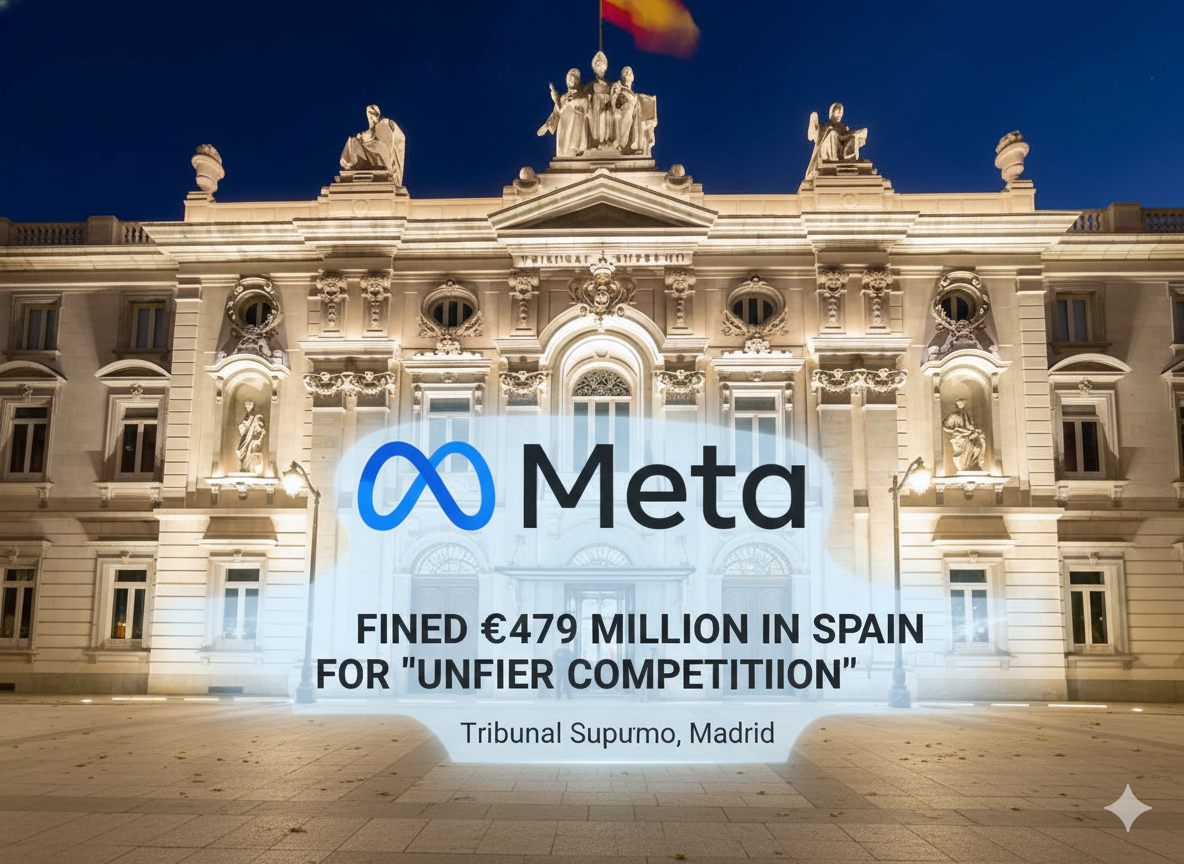
On November 19, 2025, the Madrid Commercial Court ruled that Meta must pay €479 million in compensation to 87 Spanish digital media organizations, finding that it had gained a significant competitive advantage by consistently violating GDPR regulations on personalized advertising, thus constituting unfair competition.
Quick Look
On November 19, 2025, the Madrid Commercial Court ruled that Meta must pay €479 million in compensation to 87 Spanish digital media organizations, finding that it had gained a significant competitive advantage by consistently violating GDPR regulations on personalized advertising, thus constituting unfair competition. Although Meta has stated it will appeal the case, this ruling signifies a deep integration of privacy law and competition law in European regulation, and the use of civil damages to combat tech giants. This article will analyze the legal core of the case and regulatory trends.
I. Case Review: GDPR as a Sword of Competition Law
1. Case Core and Key Ruling
This case is a class-action civil damages lawsuit based on Meta's violation of GDPR. Previously, in 2023, EU regulators had announced administrative penalties against Meta for violating GDPR, ruling that "performance of a contract" could not serve as a legal basis for using personal information for personalized advertising, and that Meta must obtain user consent. Against this backdrop, the Spanish Association of Information Media (AMI) sued Meta for civil damages caused by unfair competition.
The Madrid Commercial Court No. 15 ruled in favor of the 87 major media organizations represented by AMI.
The core of the lawsuit is that Meta, from May 2018 (when GDPR came into effect) to July 2023 (the date Meta began using user consent as its legal basis), consistently violated data protection regulations. The data processing basis previously relied upon for its personalized advertising, namely "necessity for the performance of the contract" and "legitimate interest," was deemed invalid.
The court ruled that Meta gained an illegal data advantage by violating GDPR, constituting unfair competition.
Key points of the ruling:
● Violations: Meta used Instagram and Facebook user data on a large scale to build personalized advertising profiles without effective user consent.
● Competitive Advantage: The court found that this illegally obtained data allowed Meta to provide highly targeted advertising, while traditional media could not benefit from this due to their compliance with regulations. In other words, Meta's significant competitive advantage was built on the basis of "illegal data processing." ● Nature of Compensation: The €479 million amount is not an administrative fine, but rather civil damages intended to compensate traditional media for anticipated revenue losses suffered due to Meta's unfair competitive advantage gained through the use of illegally obtained data.
2. Combination of Privacy Violations and Unfair Competition
This case, based on Article 15.1 of the Spanish Unfair Competition Law (LCD), prohibits "obtaining a significant competitive advantage through illegal acts," thus achieving a dual application of both privacy law (GDPR) and competition law.
The court's logic is: by violating the GDPR and illegally processing a large amount of data, Meta gained a significant competitive advantage that its competitors (traditional media complying with GDPR rules) could not replicate, constituting a "disruptive attack" on the market.
II. Core Disputes: Invalid Legal Basis and Economic Costs
1. Invalid Legal Basis
When the GDPR came into effect, Meta, in order to circumvent the strict "consent" requirements and reduce the negative impact on its business, changed the legal basis for processing user data for personalized advertising from "user consent" to "necessity for the performance of a service contract," which users were forced to accept.
● Meta's argument: Advertising is a necessary component of the free services provided by Facebook and Instagram; therefore, data processing is necessary for the performance of the contract.
● Court's rebuttal: The court cited rulings from the Court of Justice of the European Union (CJEU), such as Schrems v Meta, stating that continuous and systematic user tracking and profiling are not core necessities for providing social networking services. This unrestricted collection and processing of personal information was deemed to violate the principle of data minimization.
● Conclusion: Meta's personalized advertising data processing activities during this period of violation (May 2018 to July 2023) were all deemed illegal due to the lack of a valid legal basis.
2. Punitive Calculation: The Cost of Refusing to Provide Business Accounts
In calculating the compensation, the court adopted a deterrent calculation method, particularly applying the "burden of proof" rule to Meta's failure to cooperate in providing financial data:
● Determination of Illegal Revenue: The judge determined that Meta's online advertising revenue in Spain during the period of violation exceeded €5.281 billion. Because its data processing basis was illegal, the judge considered this revenue "entirely" as illegal gains obtained through violations of the GDPR. ● Burden of Proof Rule: Because Meta Ireland (Meta's headquarters in Spain) refused to provide the court with accurate business accounts for its operations in Spain, the judge invoked the "burden of proof rule." Since Meta refused to provide accurate financial data to refute the data provided by the plaintiffs, the court accepted the data provided by the plaintiffs' experts and the market share study from the Spanish National Competition Commission (CNMC), and presumed that Meta had obtained higher profits.
● Basis for Allocation: The court used Meta's illegal gains exceeding €5.281 billion as the basis for calculation, ultimately awarding €479 million to compensate the plaintiffs for their expected loss of income.
III. Macro Perspective: Coordinated Regulation of Big Tech in Europe
1. European Precedent: Competition Law Scrutiny of Data Advantages
This case's ruling can be traced back to previous precedents set by German competition regulators. As early as 2021, the German Federal Cartel Office (BKartA) ruled that Facebook abused its dominant market position by forcing users to agree to the merging of data from different platform accounts, deeming this practice illegal.
This case was ultimately decided by the CJEU, establishing a key principle linking privacy law and competition law in the context of digital markets and data advantages: when assessing monopolies or market abuse in the digital economy, competition regulators or courts should consider whether a company's actions comply with the legal requirements of the GDPR.
This principle provided direct grounds for this case, reflected in:
● Enabling the court to determine that the advantages Meta gained by violating the GDPR constituted unfair competition;
● Transforming Meta's privacy violations into civil compensation based on losses of competitive advantage in the media market. This imposed a more deterrent penalty on Meta compared to administrative fines based solely on revenue proportions.
2. Upgrading the Regulatory System: From Administrative Fines to Civil Compensation
In the data field, a dual mechanism of administrative penalties and civil compensation has become a common regulatory tool for technology companies in Europe. Under this model, administrative regulatory agencies impose administrative fines, while civil courts award compensation based on economic losses. This parallel dual mechanism significantly strengthens the deterrent effect of regulation and marks a further deepening of coordinated regulation in Europe. IV. Compliance Implications: Regulatory Impact and Corporate Response
1. Core Compliance Recommendations
● Implement the "free consent" principle: Ensure that personalized advertising obtains the explicit consent of users, and that users can still use core services even after refusing consent. Designs that require users to "click to agree" before using the service face high risks.
● Carefully evaluate the conversion of legal basis: If a company plans to change its legal basis from "consent" to "contractual necessity" or "legitimate interest," it must conduct a high-standard internal review and a thorough assessment of compliance and business risks.
● Risks of conflict between GDPR and competition law: GDPR administrative fines are levied at a certain percentage, while civil compensation is based on the actual losses or expected income losses of the victims, and may be accompanied by class-action lawsuits. The potential compensation amount often exceeds the administrative fines – both constitute cumulative economic risks. Companies should consider "data compliance" as a competitive strategy and incorporate it into enterprise-level risk assessments.
2. Subsequent Impact
Spanish Prime Minister Pedro Sanchez recently announced an investigation into Meta for improper tracking of Android users' online behavior, emphasizing that "large technology companies are not above our laws; infringing on rights will come at a cost." Meanwhile, according to foreign media reports, the Spanish Broadcasting Corporation has filed another similar lawsuit against Meta for €160 million. It is foreseeable that similar cases will continue to unfold in various European countries, and data compliance has risen to the level of a double red line of national sovereignty and business fairness.
Conclusion:
This case ruling means that the strategy of sacrificing compliance for market advantage has ended. European regulators are using a collaborative network of "competition law-privacy law" to force technology companies to consider data compliance and market fairness more in their operations.